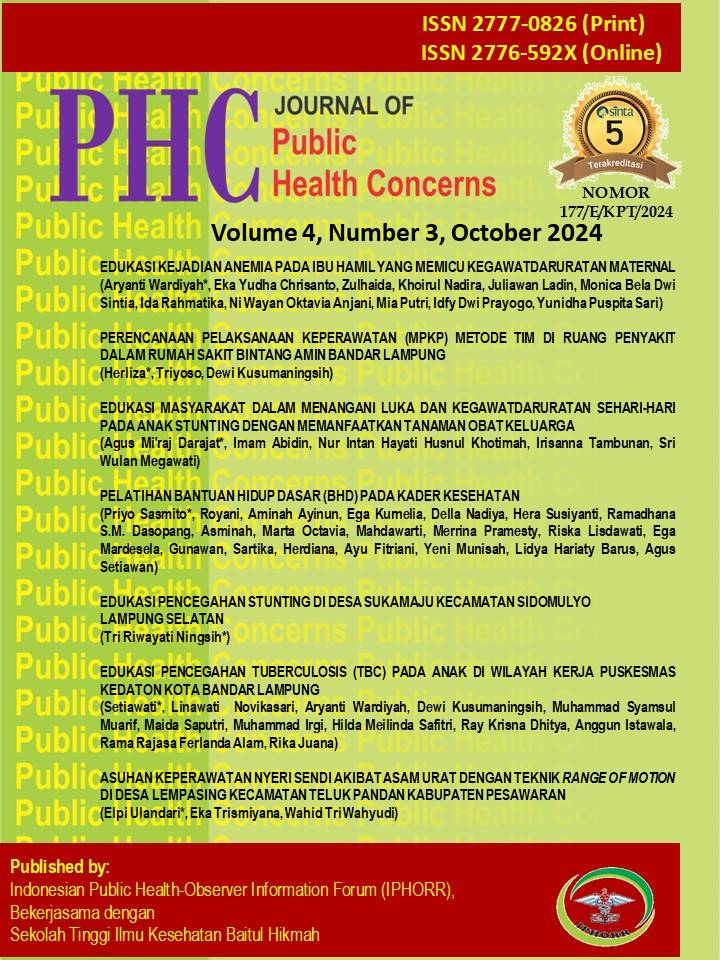
Pelatihan bantuan hidup dasar (BHD) pada kader kesehatan

DOI: https://doi.org/10.56922/phc.v4i3.447
Bantuan Hidup Dasar Henti jantung di luar rumah sakit Kegawatdaruratan Pelatihan
Abstract
Background: Most cardiac arrests occur outside of hospital settings (Out-of-Hospital Cardiac Arrest/OHCA). The low knowledge and skills of the public regarding Basic Life Support (BLS) in cardiac arrest cases is one of the factors that contribute to the low survival rates of patients experiencing cardiac arrest. Health cadres are considered to have higher health awareness than other groups in the general population, and they have the potential to receive training and education on Basic Life Support (BLS).
Purpose: To improve the understanding and skills of health cadres regarding the provision of Basic Life Support (BLS) for out-of-hospital cardiac arrest.
Method: Training was provided to health cadres in the Lengkong Gudang Timur area, Serpong, Tangerang. The material was delivered through an interactive lecture using leaflets and flipcharts as media. Participants' skills were trained using role-play methods with phantom devices. All participants underwent a pre-test and post-test before and after the training.
Results: A total of 11 health cadres participated in the activity. Participants' knowledge about cardiac arrest and Basic Life Support (BLS) increased from an average of 53.6% in the pre-test to 85.4% in the post-test, with an average improvement of 31.8%.
Conclusion: Basic Life Support (BLS) training for health cadres can improve both knowledge and skills. Further intensive training is needed to enhance retention and confidence in performing Basic Life Support (BLS) in actual cardiac arrest situations. Collaboration between the government, health organizations, and communities is needed to develop affordable and accessible training programs for all groups.
Keywords: Basic Life Support; Emergency; Out-of-Hospital Cardiac Arrest; Training
Pendahuluan: Sebagian besar henti jantung terjadi di luar rumah sakit (Out-of Hospital Cardiac Arrest/OHCA). Rendahnya pengetahuan dan keterampilan masyarakat mengenai pemberian Bantuan Hidup Dasar (BHD) pada kasus henti jantung merupakan salah satu faktor yang menyebabkan rendahnya peluang hidup pasien dengan henti jantung. Kader kesehatan dinilai memiliki kesadaran kesehatan yang lebih tinggi dibanding kelompok masyarakat awam lainnya memiliki potensi untuk diberi pelatihan dan edukasi mengenai Bantuan Hidup Dasar (BHD).
Tujuan: Untuk meningkatkan pemahaman dan keterampilan kader kesehatan mengenai pemberian Bantuan Hidup Dasar (BHD) untuk henti jantung di luar rumah sakit.
Metode: Pelatihan diberikan kepada kader kesehatan yang berada di wilayah Lengkong Gudang Timur, Serpong, Tangerang. Sebanyak 11 orang kader kesehatan terlibat dalam kegiatan ini. Pemberian materi dilakukan dengan metode ceramah interaktif menggunakan media leaflet dan lembar balik. Keterampilan peserta dilatih menggunakan metode role play dengan media phantom. Semua peserta diberikan pre-test dan post-test sebelum dan setelah pelatihan.
Hasil:. Pengetahuan mengenai henti jantung dan Bantuan Hidup Dasar (BHD) peserta dari rata-rata 53.6% saat pre-test menjadi 85.4% saat post-test dengan peningkatan rata-rata sebesar 31.8%.
Simpulan: Pelatihan Bantuan Hidup Dasar (BHD) pada kader kesehatan dapat meningkatkan pengetahuan dan keterampilan. Diperlukan pelatihan lanjutan yang lebih intensif untuk meningkatkan retensi dan kepercayaan diri dalam melakukan Bantuan Hidup Dasar (BHD) pada setting henti jantung yang sebenarnya. Perlu ada kolaborasi antara pemerintah, organisasi kesehatan, dan komunitas dalam menyusun program pelatihan yang terjangkau dan mudah diakses oleh semua kalangan.
Downloads
References
Berg, K. M., Bray, J. E., Ng, K. C., Liley, H. G., Greif, R., Carlson, J. N., & Nolan, J. P. (2023). 2023 international consensus on cardiopulmonary resuscitation and emergency cardiovascular care science with treatment recommendations: summary from the basic life support; advanced life support; pediatric life support; neonatal life support; education, implementation, and teams; and first aid task forces. Circulation, 148(24), e187-e280.
Bielski, K., Smereka, J., Chmielewski, J., Pruc, M., Chirico, F., Gasecka, A., & Szarpak, L. (2023). Meta-analysis of chest compression-only versus conventional cardiopulmonary resuscitation by bystanders for adult with out-of-hospital cardiac arrest. Cardiology journal, 30(4), 606-613.
Brent, C. M., Cheskes, S., Castrén, M., & Brooks, S. C. (2023). Wolf Creek XVII Part 5: Mobile AEDs. Resuscitation plus, 16, 100500.
Fahrurroji, A., Wicaksono, A., Fauzan, S., Fitriangga, A., Fahdi, F. K., & Nurbaeti, S. N. (2020). Penangangan Bantuan Hidup Dasar (Bhd) Dan Kesehatan Dan Keselamatan Kerja (K3) Lingkungan Rumah Tangga. Jurnal Pengabdian Kepada Masyarakat, 26(1), 47..
Gräsner, J. T., Wnent, J., Herlitz, J., Perkins, G. D., Lefering, R., Tjelmeland, I., & Bossaert, L. (2020). Survival after out-of-hospital cardiac arrest in Europe-Results of the EuReCa TWO study. Resuscitation, 148, 218-226..
Khashaba, A. S., Alharbi, M. K., Alghunaim, M. S., Alsemari, L. A., & Almohaimeed, W. S. (2021). Knowledge and awareness of basic life support among nonhealth-care providers in Riyadh. Saudi Journal of Oral Sciences, 8(1), 38-47.
Kiguchi, T., Okubo, M., Nishiyama, C., Maconochie, I., Ong, M. E. H., Kern, K. B., ... & Iwami, T. (2020). Out-of-hospital cardiac arrest across the World: First report from the International Liaison Committee on Resuscitation (ILCOR). Resuscitation, 152, 39-49.
Lafrance, M., Recher, M., Javaudin, F., Chouihed, T., Wiel, E., Helft, G., ... & Canon, V. (2023). Bystander basic life support and survival after out-of-hospital cardiac arrest: A propensity score matching analysis. The American Journal of Emergency Medicine, 67, 135-143.
Mumpuni, R. Y., Winarni, I., & Haedar, A. (2017). Pengalaman perawat puskesmas kota malang dalam penatalaksanaan henti jantung (out-of-hospital cardiac arrest). Medica Majapahit (Jurnal Ilmiah Kesehatan Sekolah Tinggi Ilmu Kesehatan Majapahit), 9(1).
Olasveengen, T. M., Mancini, M. E., Perkins, G. D., Avis, S., Brooks, S., Castrén, M., & Rajendran, K. (2020). Adult basic life support: international consensus on cardiopulmonary resuscitation and emergency cardiovascular care science with treatment recommendations. Resuscitation, 156, A35-A79.
Perkins, G. D., Handley, A. J., Koster, R. W., Castrén, M., Smyth, M. A., Olasveengen, T., & Greif, R. (2015). European Resuscitation Council Guidelines for Resuscitation 2015: Section 2. Adult basic life support and automated external defibrillation. Resuscitation, 95, 81-99..
Rea, T., Kudenchuk, P. J., Sayre, M. R., Doll, A., & Eisenberg, M. (2021). Out of hospital cardiac arrest: Past, present, and future. Resuscitation, 165, 101-109.
Witten, L., Gardner, R., Holmberg, M. J., Wiberg, S., Moskowitz, A., Mehta, S., ... & Berg, K. M. (2019). Reasons for death in patients successfully resuscitated from out-of-hospital and in-hospital cardiac arrest. Resuscitation, 136, 93-99..
Wyckoff, M. H., Singletary, E. M., Soar, J., Olasveengen, T. M., Greif, R., Liley, H. G., ... & Berg, K. M. (2022). 2021 International consensus on cardiopulmonary resuscitation and emergency cardiovascular care science with treatment recommendations: summary from the basic life support; advanced life support; neonatal life support; education, implementation, and teams; first aid task forces; and the COVID-19 working group. Circulation, 145(9), e645-e721.
Yudhiantoro, M. A., & Rizal, A. A. F. (2021). Hubungan Tingkat Pengetahuan Pertolongan Pertama Dengan Teknik Resusitasi Jantung Paru: Literrature Review. Borneo Studies and Research, 3(1), 380-390.
Downloads
Published
Issue
Section
License
Copyright (c) 2024 JOURNAL OF Public Health Concerns

This work is licensed under a Creative Commons Attribution-NonCommercial-NoDerivatives 4.0 International License.