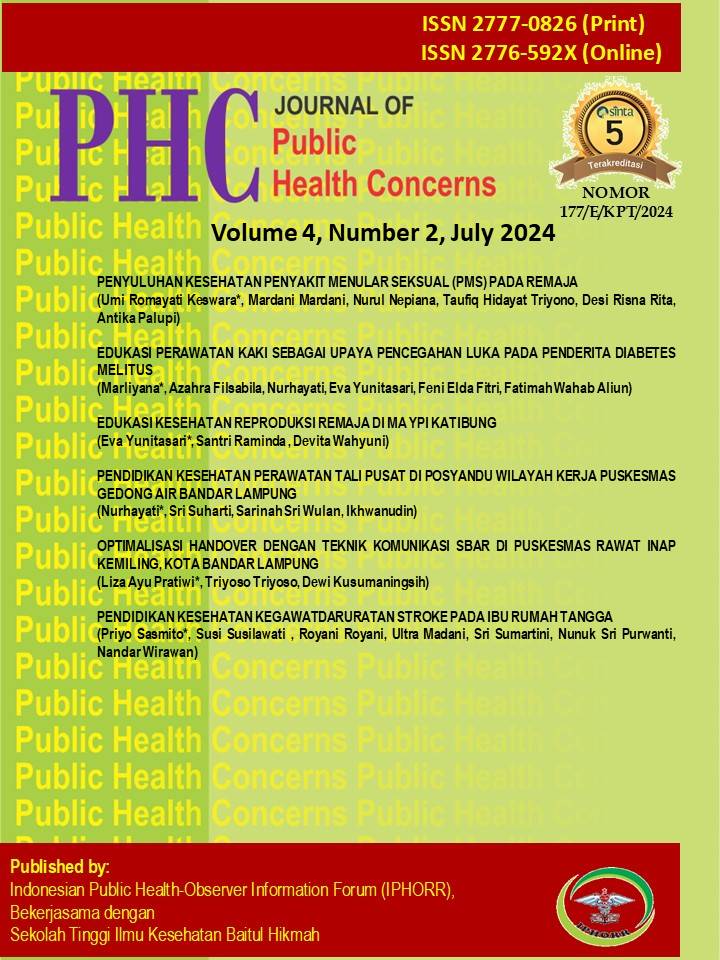
Pendidikan kesehatan kegawatdaruratan stroke pada ibu rumah tangga

DOI: https://doi.org/10.56922/phc.v4i2.446
Ibu rumah tangga Kegawatdaruratan Stroke akut Pendidikan Kesehatan.
Abstract
Background: The incidence, paralysis, and death due to stroke in Indonesia are increasing. Generally, people do not understand the signs of stroke and the importance of immediate assistance for stroke sufferers. Housewives are the component of the family who are most often at home, where strokes often begin.
Purpose: To increase the knowledge of housewives in recognizing the signs of acute stroke, emergencies that can occur, and efforts that can be made to prevent stroke.
Method: This counseling uses a lecture method with leaflet media for housewives in Sudimara Barat Village.
Results: A total of 13 participants attended this counseling. Education was carried out by providing material on the understanding of stroke, causes of stroke, signs and symptoms of stroke, risk factors for stroke, stroke complications, foods to avoid in stroke patients, how to prevent recurrent stroke and how to modify the home environment. The average knowledge of participants increased from 40% to 80%.
Conclusion: Health education on stroke emergencies can increase housewives' knowledge of stroke emergencies and preventive measures that can be taken. With increased knowledge, it is hoped that it can increase public awareness of the importance of immediate assistance for acute stroke.
Keywords: Acute stroke; Emergencies; Health education; Housewives
Pendahuluan: Angka kejadian, kelumpuhan, dan kematian akibat stroke di Indonesia kian meningkat. Umumnya masyarakat kurang memahami tanda-tanda stroke serta pentingnya pertolongan segera pada penderita stroke. Ibu rumah tangga adalah komponen dalam keluarga yang paling sering berada di rumah, dimana stroke seringkali berawal.
Tujuan: Untuk meningkatkan pengetahuan ibu rumah tangga dalam mengenali tanda-tanda terjadinya stroke akut, kegawatdaruratan yang dapat terjadi, serta upaya yang dapat dilakukan untuk mencegah terjadinya stroke.
Metode: Penyuluhan ini menggunakan metode ceramah dengan media leaflet pada ibu rumah tangga di Kelurahan Sudimara Barat.
Hasil: Sebanyak 13 partisipan menghadiri penyuluhan ini. Edukasi dilakukan dengan pemberian materi mengenai pengertian tentang stroke, penyebab terjadinya stroke, tanda dan gejala stroke, factor resiko terjadinya stroke, komplikasi stroke, makanan yang dihindari pada pasien stroke, cara mencegah stroke berulang dan cara memodifikasi lingkungan rumah. Rata-rata pengetahuan partisipan meningkat dari 40% menjadi 80%.
Simpulan: Penyuluhan kesehatan tentang kegawatdaruratan stroke dapat meningkatkan pengetahuan ibu rumah tangga tentang kegawatdaruratan stroke serta upaya pencegahan yang dapat dilakukan. Dengan meningkatnya pengetahuan diharapkan dapat meningkatkan kesadaran masyarakat tentang pentingnya pertolongan segera pada stroke akut.
Downloads
References
Abbasian, M., Birgani, H. R., Khabiri, R., Namvar, L., & Jahangiry, L. (2024). Exploring Education Interventions for Stroke Prevention Among Adults and Older Individuals: A Scoping Review. Health Science Reports, 7(11), e70167.
Chen, J., Zhu, Q., Yu, L., Li, Y., Jia, S., & Zhang, J. (2022). Stroke risk factors of stroke patients in China: a nationwide community-based cross-sectional study. International Journal of Environmental Research and Public Health, 19(8), 4807.
Feigin, V. L., Brainin, M., Norrving, B., Martins, S., Sacco, R. L., Hacke, W., & Lindsay, P. (2022). World Stroke Organization (WSO): global stroke fact sheet 2022. International Journal of Stroke, 17(1), 18-29.
Finch, E., Minchell, E., Cameron, A., Jaques, K., Lethlean, J., Shah, D., & Moro, C. (2022). What do stroke survivors want in stroke education and information provision in Australia?. Health & social care in the community, 30(6), e4864-e4872.
Gorelick, P. B. (2019). The global burden of stroke: persistent and disabling. The Lancet Neurology, 18(5), 417-418.
Haesebaert, J., Laude, C., Termoz, A., Bravant, E., Perreton, N., Bony, T., & Schott, A. M. (2020). Impact of a theory-informed and user-centered stroke information campaign on the public’s behaviors, attitudes, and knowledge when facing acute stroke: a controlled before-and-after study. BMC Public Health, 20, 1-9.
Johnson, W., Onuma, O., Owolabi, M., & Sachdev, S. (2016). Stroke: a global response is needed. Bulletin of the World Health Organization, 94(9), 634.
Kim, J., Thayabaranathan, T., Donnan, G. A., Howard, G., Howard, V. J., Rothwell, P. M., & Thrift, A. G. (2020). Global stroke statistics 2019. International Journal of Stroke, 15(8), 819-838.
Owolabi, M. O., Thrift, A. G., Martins, S., Johnson, W., Pandian, J., Abd-Allah, F., & Stroke Experts Collaboration Group. (2021). The state of stroke services across the globe: Report of World Stroke Organization–World Health Organization surveys. International Journal of Stroke, 16(8), 889-901.
Putri, I., & Romadoni, S. (2023). The Effect of Educational Media Booklet on Family Knowledge About Early Stroke Detection. Jurnal Inspirasi Kesehatan, 1(2), 235-244.
Saposnik, G., Galanos, L. C., Guerrero, R., Casagrande, F., Adhamidhis, E., Gao, M. M. Y., & Arsovska, A. (2022). The World Stroke Academy: a World Stroke Organization global pathway to improve knowledge in stroke care. International Journal of Stroke, 17(8), 829-834.
Zhang, X., & Bi, X. (2020). Post-stroke cognitive impairment: a review focusing on molecular biomarkers. Journal of Molecular Neuroscience, 70(8), 1244-1254.
Downloads
Published
Issue
Section
License
Copyright (c) 2024 JOURNAL OF Public Health Concerns

This work is licensed under a Creative Commons Attribution-NonCommercial-NoDerivatives 4.0 International License.